
Asbestos Removal Central Coast
Licensed asbestos removal, testing and demolition across the Central Coast, from Gosford and the Woy Woy peninsula to Wyong, The Entrance and Toukley. SafeWork NSW licence AD213403. Class A friable and Class B bonded work, NATA-accredited testing and EPA-approved disposal, carried out by our own crew.
Call 0452 224 398 for a free on-site quote.
Licensed asbestos removal from Gosford to Wyong
Hazardous Removal Company has been removing asbestos on the Central Coast for more than a decade. We handle the whole job: the inspection and sampling, the SafeWork NSW notification, the removal, transport and disposal, air monitoring where the work calls for it, and the clearance certificate at the end so you can move back in or hand the site to your builder.
We hold SafeWork NSW asbestos removal licence AD213403. That covers bonded (non-friable) materials such as fibro wall sheeting, eaves and Super Six roofing, and friable materials such as pipe lagging, loose insulation and badly weathered or fire-damaged sheeting, which by law can only be removed by a Class A licensed removalist. A lot of contractors on the Coast can quote the first kind of job and not the second. We do both.
Every job is done by our own licensed technicians. We do not subcontract the dangerous part of the work to a crew you have never met, and the person who quotes the job is the person who runs it.
- SafeWork NSW licence AD213403, Class A and Class B
- Samples tested at a NATA-accredited laboratory, results in writing
- Waste transported and disposed of at an EPA-licensed facility, with documentation
- Independent clearance certificates from a licensed asbestos assessor
- Free on-site quotes, and a reply to every enquiry within 24 hours
Licensed asbestos removal across the Central Coast. SafeWork NSW licence AD213403, Class A and B.
Our asbestos services on the Central Coast
Asbestos removal, bonded and friable
Fibro sheeting, roofing, eaves, fences, floor coverings and internal linings, removed whole where possible, wrapped and sealed on site, with exposed frames sealed with PVA. Friable asbestos is handled under Class A conditions with full enclosure and negative air, and where removal has to wait, encapsulation seals the material safely.
Asbestos testing and inspection
Not sure whether a material contains asbestos? We take samples on site and send them to a NATA-accredited laboratory, and you get the result in writing. Pre-purchase and pre-renovation inspections tell you what you are dealing with before a tradie cuts into it. More on asbestos testing.
Demolition with asbestos removal
Garages, sheds, granny flats and full house demolitions on the Coast very often involve asbestos. We do both stages, the licensed removal and then the demolition, with the same crew and one clearance certificate, so there is no gap between two contractors and no argument about who was responsible.
Asbestos disposal
Transport and disposal at an EPA-licensed facility is included in every removal job. Sheets are wrapped in heavy plastic, sealed and labelled before they leave the site, and you receive the waste documentation that proves where it went, which a buyer, insurer or certifier may ask to see later.
Air monitoring and clearance
Air monitoring runs during friable work and a clearance inspection and certificate closes out every licensed removal. Both are carried out by an independent licensed assessor, not by the crew that did the removal, and you receive the certificate before the area is re-occupied or the next trade starts.
Asbestos registers and plans
Commercial premises, strata buildings, clubs, schools and childcare centres built before 2004 are required to keep an asbestos register and management plan. We survey the building, identify and label the materials, and produce the register and plan your WHS obligations call for, in a form your managers can use.
Where asbestos still sits in Central Coast homes
The Coast grew fast between the 1950s and the 1980s, and a large share of that housing was built in fibro. Post-war cottages on the Woy Woy peninsula, beach houses at The Entrance, Toukley and Bateau Bay, and the first estates around Wyong, Berkeley Vale and Chittaway Bay all went up when asbestos cement sheeting was the cheapest cladding available. Anything built or extended before 1990 should be treated as suspect until it has been tested.
On Central Coast jobs we most often find asbestos in:
- External fibro wall cladding, gable ends and eaves linings
- Super Six corrugated roofing on garages, carports, sheds and older homes
- Bathroom, kitchen and laundry wall linings, usually behind tiles
- Fences, and the fibro sheeting on old outbuildings and chook sheds
- Vinyl floor tiles and the backing under old lino
- Pipe lagging and switchboard backing in older commercial buildings and clubs
Salt air and storms matter here. Weathered fibro and cracked roof sheeting release fibres far more readily than intact material, and storm damage is one of the most common reasons we are called to coastal properties. If a sheet has been broken, do not sweep it up or put it in the bin. Wet it down, keep people and pets away from it, and call us.
Where we work on the Coast
We cover the whole Central Coast Council area. These are the areas we are in most often.
Gosford and the west
Gosford, West Gosford, East Gosford, Point Clare, Tascott, Kariong, Somersby, Narara, Wyoming, Niagara Park and Lisarow. A mix of older fibro housing and post-1970s brick veneer, with asbestos most often turning up in eaves, garages and wet-area linings.
Wyong, Tuggerah and the north
Wyong, Tuggerah, Watanobbi, Mardi, Warnervale, Hamlyn Terrace, Blue Haven and Kanwal. Some of the oldest fibro stock on the Coast sits around Wyong itself, and the newer estates to the north often have an old fibro shed or fence left over from the original block.
Terrigal, Erina and the coast road
Terrigal, Wamberal, Avoca Beach, North Avoca, Erina, Kincumber, Green Point, Saratoga and Davistown. Weathered external cladding and roofing are the usual jobs here, and access can be awkward on sloping beachside blocks. See the Terrigal job below.
The Entrance to Berkeley Vale
The Entrance, Long Jetty, Bateau Bay, Shelly Beach, Killarney Vale, Toowoon Bay, Tumbi Umbi, Berkeley Vale, Glenning Valley and Chittaway Bay. Beach-house fibro and 1970s estates side by side, and a lot of bathroom and kitchen renovation work.
Toukley, Budgewoi and the lakes
Toukley, Gorokan, Lake Haven, Budgewoi, Noraville, Norah Head, Charmhaven, San Remo and Doyalson. Older lakeside cottages, garages and sheds.
Woy Woy and the peninsula
Woy Woy, Umina Beach, Ettalong Beach, Blackwall, Booker Bay, Pearl Beach and Empire Bay. Post-war fibro cottages are still common on the peninsula and most of them have never been tested.
If your suburb is not listed, call us anyway. We travel across the Coast and into the Hunter for the right job.
How a Central Coast job runs
- Call or send us photos. We give you a free on-site quote. If the material is not obviously asbestos we take samples and have them tested first, so you are not paying for licensed removal of something that turns out to be plasterboard.
- Fixed quote in writing covering removal, disposal and the clearance certificate. No surprises on the day.
- SafeWork NSW notification. Licensed removal work must be notified at least five days before it starts. We lodge it and manage the timing.
- Site set-up. Signage and barriers, PPE, a decontamination area, and for friable work a sealed enclosure under negative air.
- Removal. Sheets are wetted down and removed whole where possible, wrapped in heavy plastic, sealed and labelled. Frames and cut edges are sealed with PVA.
- Transport and disposal at an EPA-licensed facility, with waste tracking documentation supplied to you.
- Clearance inspection and certificate from an independent licensed asbestos assessor before the area is handed back.
Recent job: 120 m² of fibro cladding removed in Terrigal
A home in Terrigal had damaged flat asbestos sheeting on its external walls, and the owners wanted it replaced with non-hazardous cladding. We removed 120 m² of sheeting.
Because the job was well over 10 m², a SafeWork NSW notification was lodged before we started. Six licensed technicians were on site. After the paperwork and a toolbox talk, the team set the site up to contain any contamination, and because of the height of the walls and eaves we erected temporary scaffolding to reach and remove the cladding safely.
The sheets came off whole, were wrapped and sealed on site and taken to a licensed facility. Once the walls were stripped, an independent licensed hygienist inspected the site and issued the clearance certificate, and the builder was able to start on the new cladding.
Read the full Terrigal project write-up. The photos alongside are from recent HRC removal jobs and show the kind of strip-out involved.
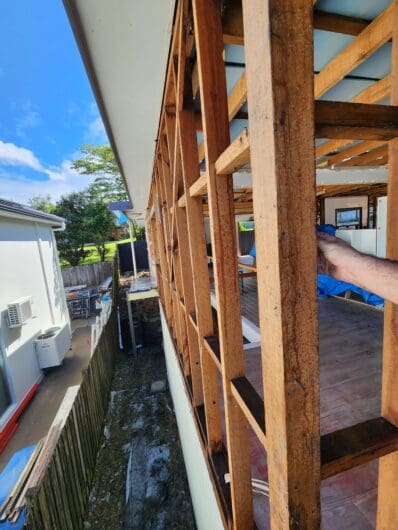
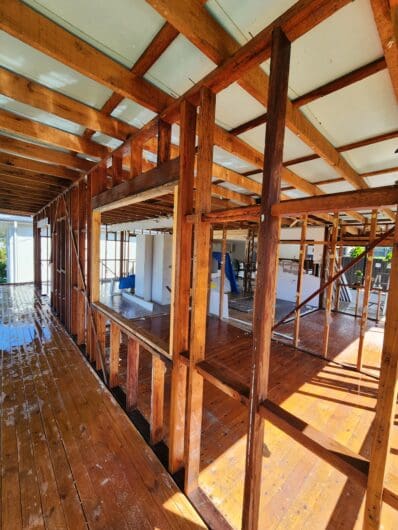
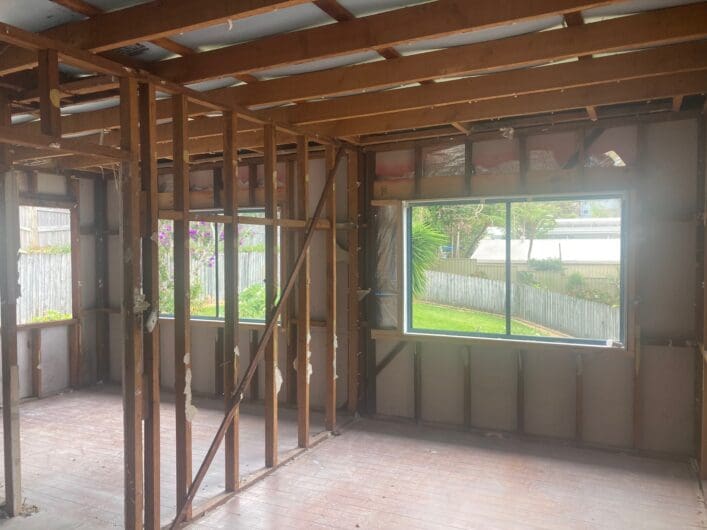
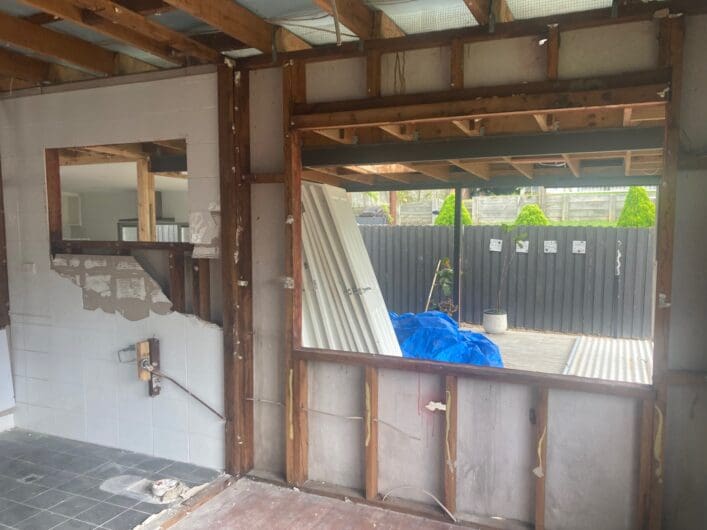
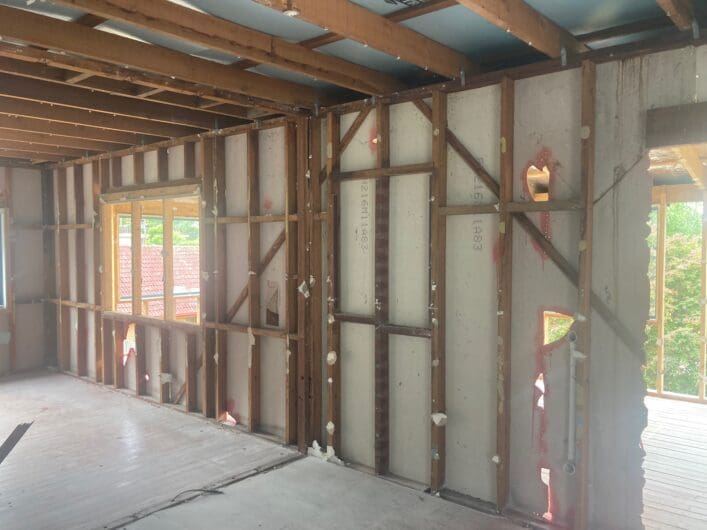
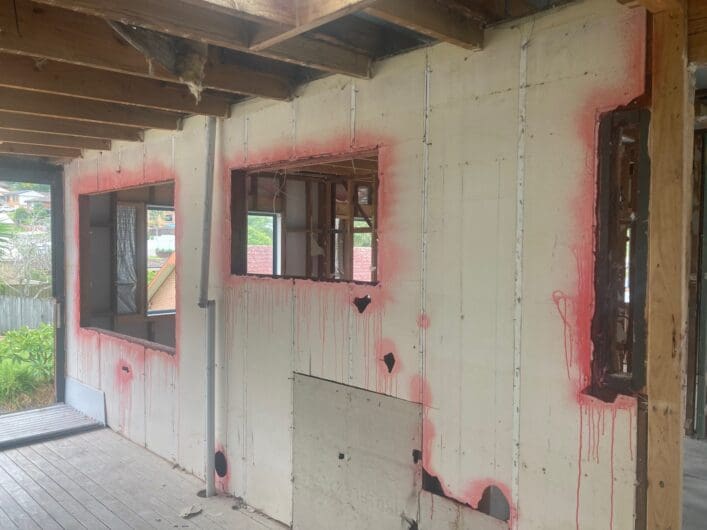
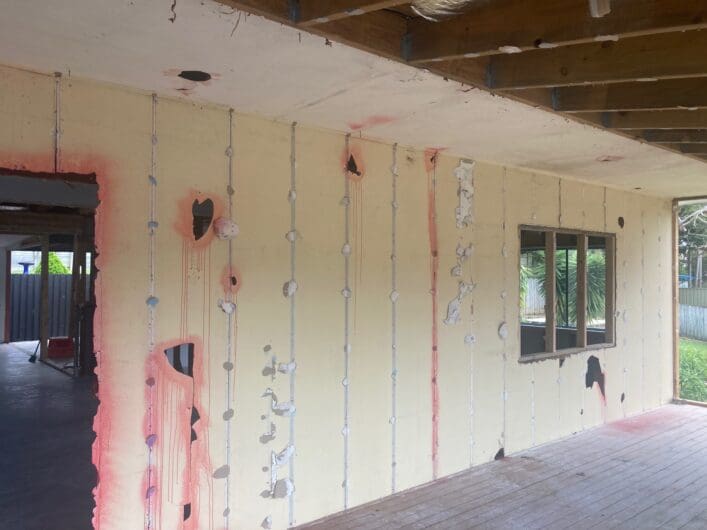
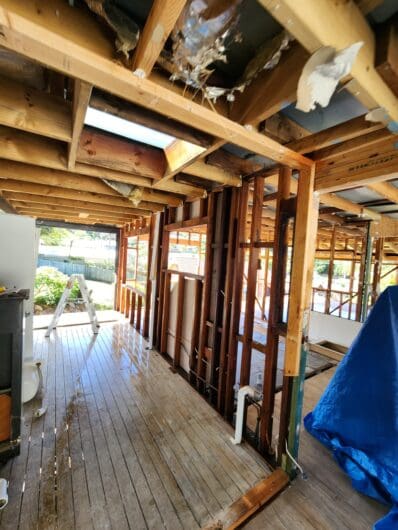
Photos: recent HRC asbestos removal jobs. Fibro wall linings and external cladding stripped, with the exposed frames and cut edges sealed with PVA before the clearance inspection.
Central Coast asbestos questions
Straight answers to the questions we get asked most on Coast jobs. If yours is not here, call 0452 224 398.
It depends on the amount of material, whether it is bonded or friable, how hard it is to reach (height, scaffolding, tight side access on beachside blocks) and how much waste has to be transported. A single garage or bathroom lining is a very different job to the full cladding of a house. We quote every job fixed after seeing it. Our asbestos removal cost guide explains what drives the price.
In NSW, up to 10 m² of bonded asbestos can legally be removed without a licence, but the disposal, wrapping and safety rules still apply and most people underestimate both the quantity and the risk. Friable asbestos always needs a Class A licensed removalist regardless of size. We have written about why the 10 m² rule causes more harm than it prevents.
Yes. All licensed asbestos removal work has to be notified to SafeWork NSW at least five days before it starts. We lodge the notification as part of the job and build the notice period into the schedule.
Some waste facilities accept small, properly wrapped and labelled quantities from householders by prior arrangement, but the wrapping, labelling and transport rules are strict and it is easy to get wrong. Disposal is included in every removal job we do, with the paperwork that shows where the waste went.
A clearance certificate confirms that a licensed asbestos assessor has inspected the area after removal and found it safe to re-occupy. It is required after all licensed removal work in NSW, and it is what your builder, your certifier or a future buyer will ask to see. We arrange it through an independent assessor on every job.
We reply to every enquiry within 24 hours and give you a start date when we quote. Storm damage and broken sheeting are treated as urgent.
Yes. Commercial premises, strata buildings, clubs, schools and childcare centres are a regular part of our Central Coast work, including asbestos registers, management plans and staged removals that fit around a working site.
Send an enquiry
We respond to enquiries within 24 hours.
Hazardous Removal Company?
Why choose
Quick turn-around.
Our dedicated team of experienced professionals are fast and efficient while maintaining safety as priority.
Safe & professional work practice.
Safety of our clients and workers is paramount to our service. We ensure all work is conducted to current safe work NSW current safety standard.
Quality services.
Ensuring customer satisfaction and quality of work through every stage of the project.
24-hour response time.
We respond to all enquiries within 24 hours.
500+ Satisfied Customers
Worried about asbestos in your home? Join over 500 satisfied customers who have trusted Hazardous Removal Company to ensure a safe living environment.
5 Star Reviews
★★★★★
Your Safety is Our Priority. We pride ourselves on providing you the best and most efficient service.