
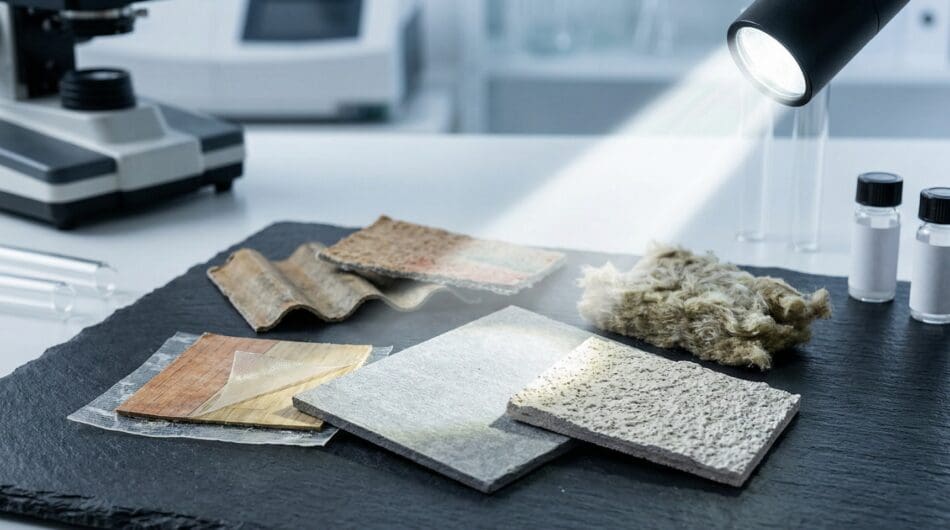
There is a common belief among homeowners and even some tradespeople that you can tell whether a material contains asbestos just by looking at it. Grey, flat cement sheeting? Probably asbestos. Corrugated roofing on a fibro home? Almost certainly. White, crumbly pipe insulation? Obviously asbestos.
Sometimes those guesses are right. But “sometimes right” is not good enough when the consequences of being wrong include inhaling fibres that can cause fatal lung diseases decades later.
Visual identification of asbestos is unreliable. It always has been. Here is why.
The Core Problem: Asbestos Does Not Have One Look
Asbestos was not a single product with a single appearance. It was a raw mineral fibre mixed into more than 3,000 different manufactured products across the 20th century. The final products ranged from rigid cement sheeting to soft insulation blankets, from vinyl floor tiles to adhesive mastics, from roof shingles to electrical switchboard panels.
Each product looked different because the base materials and manufacturing processes were different. The asbestos content varied from as low as 5% to as high as 100% depending on the application. In many products, the asbestos fibres are completely invisible to the naked eye because they are bound into a cement, vinyl, or resin matrix.
This means there is no single colour, texture, or pattern that reliably identifies a material as asbestos-containing. A flat grey sheet could be asbestos cement or fibre cement manufactured after the ban. A textured ceiling could contain chrysotile or be a standard plaster finish. A vinyl floor tile could have asbestos backing or be completely clean.
Without laboratory analysis, you are guessing. And the stakes of guessing wrong go in both directions.
Getting It Wrong in Both Directions
Visual misidentification creates two types of errors, and both carry real costs.
False Negatives: Missing Asbestos That Is There
This is the dangerous error. A homeowner or tradesperson looks at a material, decides it is not asbestos, and proceeds to cut, drill, sand, or demolish it. If the material does contain asbestos, fibres are released into the air.
False negatives happen most often with materials that do not match the popular image of asbestos. The average person pictures fibro sheeting when they think of asbestos. They do not picture:
Vinyl floor tiles. Many vinyl tiles manufactured between the 1950s and 1980s contain asbestos in the tile body or in the adhesive backing. They look like ordinary floor tiles. Removing them with a scraper or chisel can release fibres from the tile and the underlying mastic.
Backing boards behind tiles. In older bathrooms, asbestos cement sheeting was commonly used as a water-resistant backing behind ceramic wall tiles. The asbestos is hidden until the tiles are removed. Many renovators strip tiles without knowing what is underneath.
Electrical meter boards and switchboard panels. Asbestos cement was used for electrical backing boards because of its fire resistance. These boards are often small, painted over, and not recognised as asbestos-containing.
Textured coatings and joint compounds. Some decorative textured ceiling coatings and plasterboard joint compounds contained asbestos. They look identical to non-asbestos versions of the same products.
Pipe lagging and gaskets. Asbestos insulation on hot water pipes, flues, and boilers can look like standard insulation or packing material. When deteriorated, it may appear as loose, dustite-like material that does not immediately register as asbestos.
In each of these cases, the material does not look like “asbestos” to an untrained eye. The risk is that it gets disturbed without any safety precautions.
False Positives: Assuming Asbestos When It Is Not There
The opposite error is less dangerous but still costly. A homeowner assumes every piece of cement sheeting in their 1975-built home must contain asbestos and avoids any renovation work for years. Or they pay for full asbestos removal of a material that turns out to be asbestos-free fibre cement manufactured after the ban.
Post-ban fibre cement products (manufactured after 31 December 2003) look virtually identical to pre-ban asbestos cement products. The only reliable way to distinguish them is laboratory analysis or verified manufacturing records.
A false positive does not create a health risk, but it can result in unnecessary spending on removal, unnecessary project delays, and unnecessary anxiety. A $300 laboratory test would have resolved the question in a few days.
Why Tradespeople Get It Wrong Too
It is not just homeowners who rely on visual identification. Builders, plumbers, electricians, and renovation contractors regularly make assumptions about materials they encounter on the job.
This is understandable. Tradespeople work across dozens of properties and develop a practical sense for what materials are likely to contain asbestos based on the building’s age and construction type. Their instincts are right more often than a homeowner’s. But instinct is not identification.
SafeWork NSW has documented cases where experienced tradespeople disturbed asbestos because the material did not match their mental model of what asbestos looks like. A plumber cutting through a pipe lagging compound. An electrician drilling through a backing board. A tiler stripping a wall without checking the substrate.
In each case, the tradesperson was not being reckless. They simply did not recognise the material because it did not look like the asbestos they were trained to spot.
This is precisely why the How to Safely Remove Asbestos Code of Practice emphasises that any material suspected of containing asbestos must be treated as asbestos-containing until laboratory analysis confirms otherwise. The precautionary principle exists because visual identification is not reliable enough to bet your health on.
What Professional Identification Actually Involves
When a licensed assessor inspects a property for asbestos, they do not rely on visual identification alone. The process involves multiple steps.
Building history review. The assessor considers the age of the building, the construction methods used, and the types of materials commonly installed during that era. This narrows down which materials are likely to contain asbestos and which are unlikely.
Systematic inspection. The assessor physically inspects all accessible areas of the property, including walls, ceilings, floors, wet areas, eaves, roofing, garages, outbuildings, and service areas. They are looking for materials that match known asbestos product types, but they are also looking for materials that might be overlooked by a non-specialist.
Sample collection. When a material is suspected of containing asbestos, the assessor collects a small physical sample. The sample is taken using techniques that minimise fibre release: wetting the material, using hand tools (not power tools), and sealing the sample in a labelled container.
Laboratory analysis. The sample is sent to a NATA-accredited laboratory for analysis using Polarised Light Microscopy (PLM) or another approved method. The lab confirms whether asbestos is present, identifies the type (chrysotile, amosite, crocidolite), and reports the approximate fibre content.
This process takes the guesswork out of the equation entirely. The result is a factual answer, not an opinion.
The Cost of Certainty vs. the Cost of Guessing
Professional asbestos testing for a standard residential property with three to five sample locations typically costs between $200 and $600. The turnaround time is usually three to five business days for standard service, with rush options available.
Compare that to the cost of guessing wrong.
A false negative that leads to fibre disturbance can result in site contamination, decontamination costs of $3,000 to $30,000 or more, project delays, health exposure, and potential SafeWork NSW involvement.
A false positive that leads to unnecessary removal can add thousands of dollars to a renovation budget for work that was never needed.
In both cases, a $300 lab test would have provided the answer. The cost of certainty is always lower than the cost of guessing.
What You Should Do Before Any Renovation
If your Sydney home was built before 1990, assume that any material you plan to disturb could contain asbestos until proven otherwise. This is not pessimism. It is the same approach that licensed assessors, removalists, and SafeWork NSW recommend.
Before starting any renovation, maintenance, or demolition work:
- Arrange a professional asbestos inspection with a licensed assessor
- Have suspect materials sampled and sent to a NATA-accredited lab
- Wait for the results before any work begins
- If asbestos is confirmed, engage a licensed asbestos removalist before your renovation contractor starts
This sequence protects your family, your workers, and your renovation budget.
Contact Hazardous Removal Company for professional asbestos testing across the Sydney region. We use NATA-accredited laboratories and provide clear, explained results. SafeWork NSW licence AD213403.