
It sounds like a simple question. You want the old garage gone. It needs to come down. Do you demolish the whole thing in one hit, or do you strip the asbestos out first and then demolish what is left?
The answer is clear under NSW law and under basic safety logic: asbestos removal comes first. Always. But the number of garage demolitions across Sydney where this sequence gets reversed, skipped, or ignored suggests that the answer is not as obvious as it should be.
Here is why the order matters, what the regulations require, and what happens when people get it wrong.
The Correct Sequence
For any garage built before 1990 that contains or may contain asbestos-containing materials, the process follows a defined order.
Step 1: Testing
Before anything is touched, the garage materials need to be tested. A licensed assessor collects samples from wall sheeting, ceiling linings, roof sheeting, and any other suspect materials. The samples go to a NATA-accredited laboratory for analysis.
This step confirms whether asbestos is present, what type it is (chrysotile, amosite, crocidolite), and in what materials. It takes three to five business days for standard turnaround.
If no asbestos is detected, the garage can be demolished using standard methods.
If asbestos is confirmed, the sequence moves to Step 2.
Step 2: Asbestos Removal
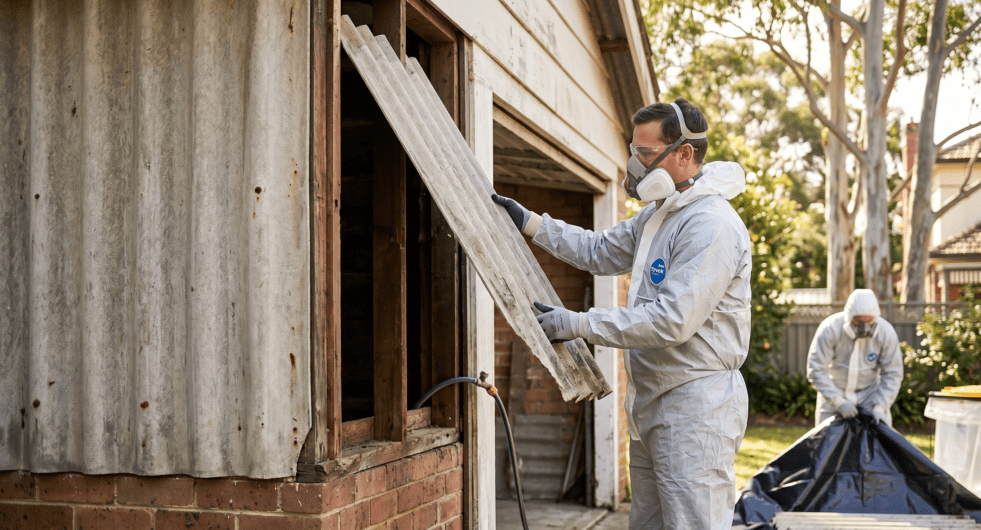
A licensed asbestos removalist strips all asbestos-containing materials from the garage structure. This is done under controlled conditions: wetting the material, using hand tools (not power tools on asbestos), carefully lowering sheets rather than dropping them, double-wrapping the waste in heavy-duty polyethylene, and decontaminating the work area.
For a typical single garage with asbestos wall and roof sheeting, this process takes one to two days depending on the quantity and accessibility.
The asbestos waste is transported to an EPA-licensed disposal facility with waste tracking documentation.
Step 3: Clearance
After the asbestos is removed, an independent licensed assessor inspects the garage structure and issues a clearance certificate confirming that all asbestos-containing materials have been removed and the site meets safe reoccupation standards.
If air monitoring was conducted during the removal (required for friable asbestos or larger bonded jobs), the results are included in the clearance documentation.
Step 4: Demolition
With the clearance certificate in hand, the remaining garage structure (timber framing, concrete slab, metal roofing if applicable) can be demolished using standard demolition methods. The demolition contractor can use power tools, heavy machinery, and standard waste disposal without asbestos-related restrictions.
The demolition waste is clean construction and demolition waste. It can go to a standard waste facility at standard rates. No special handling, no asbestos labelling, no EPA-licensed disposal required for the remaining materials.
Step 5: Site Clearance
After demolition, the site is cleared and ready for whatever comes next: a new garage, a carport, landscaping, or a new structure.
If there is any concern about soil contamination from decades of asbestos roof or wall deterioration, soil sampling can be arranged at this stage.
Why the Order Cannot Be Reversed
Some homeowners and demolition contractors want to demolish the garage in one pass. Remove the asbestos and demolish the structure simultaneously. It is faster and cheaper on paper. But it creates problems that far outweigh the time saved.
Mixing asbestos and non-asbestos waste. When a garage is demolished in one pass, asbestos-containing materials get mixed with timber, concrete, metal, and other clean demolition waste. The entire waste load is now classified as asbestos-contaminated. It must all go to an EPA-licensed facility at asbestos disposal rates, even the timber and concrete that would otherwise be recyclable or disposed of cheaply.
For a single garage demolition, this can add $2,000 to $5,000 in additional disposal costs compared to separating the waste streams.
Uncontrolled fibre release. Demolishing a garage with asbestos materials in place means breaking asbestos cement with excavators, bobcats, or sledgehammers. Every impact generates airborne fibres. Without the wetting, containment, and controlled handling that a licensed removalist applies, fibre release is uncontrolled and can affect workers, the homeowner, and neighbouring properties.
No clearance certificate. If asbestos is removed during a general demolition rather than by a licensed removalist with a clearance inspection, there is no independent verification that the site is clean. Future buyers, council inspectors, or tradespeople working on the site have no documentation confirming that asbestos was handled properly.
Legal exposure. Under the Work Health and Safety Regulation 2017, asbestos removal must be performed by a person holding a SafeWork NSW asbestos removal licence (Class A or Class B depending on the material type). A demolition contractor who removes asbestos without the appropriate licence is committing an offence. The property owner who engages them may share liability.
What Happens When Contractors Skip the Sequence
The most common scenario where the sequence breaks down involves demolition contractors who treat asbestos removal as part of their scope rather than a separate, licensed activity.
A homeowner engages a demolition contractor to remove an old garage. The contractor arrives, sees fibro sheeting on the walls, and proceeds to demolish the structure anyway. The sheeting gets broken up, loaded into a truck or skip, and taken away. No testing. No licensed removalist. No clearance certificate. No waste tracking documentation.
In many cases, the homeowner never knows the difference. The garage is gone. The site looks clean. The invoice is paid.
The problems surface later.
Council or SafeWork NSW inquiry. If a neighbour reports the demolition, or if council records show a pre-1990 garage was demolished without asbestos clearance documentation, the homeowner may receive an inquiry. Without a clearance certificate and waste tracking records, the homeowner cannot demonstrate compliance.
Future construction complications. When the homeowner applies for a Development Application (DA) to build a new structure on the garage site, council may ask for evidence that asbestos was properly removed from the previous structure. Without documentation, the homeowner may need to arrange soil testing and retrospective site assessment before the DA is approved.
Property sale issues. Buyers and their solicitors are increasingly aware of asbestos history. A property where a pre-1990 garage was demolished without asbestos documentation raises questions during due diligence. The absence of records does not prove a problem, but it cannot disprove one either.
The Cost Comparison
Homeowners who skip the proper sequence usually do so because they believe it saves money. Here is how the costs compare.
Proper Sequence (Test, Remove, Clear, Demolish)
| Item | Typical Cost |
|---|---|
| Asbestos testing (3 to 4 samples) | $250 to $450 |
| Licensed asbestos removal (single garage) | $2,500 to $6,000 |
| Clearance certificate | Included in removal quote |
| Standard demolition (clean structure) | $1,500 to $3,500 |
| Clean waste disposal | $500 to $1,500 |
| Total | $4,750 to $11,450 |
Skipped Sequence (Demolish Everything Together)
| Item | Typical Cost |
|---|---|
| Demolition (all materials together) | $2,000 to $4,000 |
| Asbestos-contaminated waste disposal (entire load) | $3,000 to $7,000 |
| Potential soil remediation (if contamination found later) | $5,000 to $15,000 |
| Retrospective site assessment (if required by council) | $1,500 to $3,000 |
| SafeWork NSW penalty (if breach identified) | $3,600 to $50,000+ |
| Total | $2,000 to $79,000+ |
The “cheap” approach has a best case that saves a few thousand dollars. It has a worst case that costs tens of thousands more than the proper approach. The proper approach has a predictable, bounded cost with no risk of penalties, remediation, or retrospective assessments.
How to Get the Sequence Right
If you are planning to demolish or replace a garage on a pre-1990 Sydney property, follow this checklist.
Arrange asbestos testing first. Contact a licensed assessor or a company like Hazardous Removal Company to test the garage materials before engaging a demolition contractor. Testing costs are minimal relative to the total project.
Engage a licensed asbestos removalist. If asbestos is confirmed, engage a removalist who holds a current SafeWork NSW licence. Confirm that a clearance certificate will be issued by an independent assessor after removal.
Engage the demolition contractor second. Once the clearance certificate is in hand, the demolition contractor can proceed with confidence that the remaining structure is clean. They can use their standard methods and dispose of waste through standard channels.
Keep all documentation. File the lab test results, the clearance certificate, waste tracking documentation, and disposal receipts with your property records. These documents protect you during future council applications, property sales, and any questions about the site’s history.
Check council requirements. Some Sydney councils require notification or a DA for garage demolition. Check with your local council before starting any work. If a DA is required, having asbestos clearance documentation ready will streamline the approval process.
Get It Done in the Right Order
The sequence for a garage demolition involving asbestos is not complicated. Test, remove, clear, demolish. Four steps in the right order. The cost is predictable. The documentation is complete. The site is clean.
Getting it wrong creates legal risk, financial exposure, and potential health consequences that far exceed the cost of doing it properly.
Contact Hazardous Removal Company for garage asbestos testing or removal anywhere in the Sydney region. We hold SafeWork NSW licence AD213403 and coordinate with demolition contractors to keep your project on schedule.