
At some point, every homeowner who has dealt with asbestos removal thinks about the same question: what does this mean when I sell?
The answer depends almost entirely on documentation. A property where asbestos was professionally tested, removed, and cleared with proper paperwork is in a strong position. A property where asbestos was “dealt with” at some point but nobody can prove how, when, or by whom faces questions that can delay settlement, reduce offers, or kill a deal entirely.
Here is what buyers and their solicitors are looking for, and how to make sure your property records are complete.
The Disclosure Landscape in NSW
NSW does not have a mandatory asbestos disclosure requirement for residential property sales in the same way that some US states require lead paint disclosure. There is no standardised form that asks, “Does this property contain asbestos?”
However, the general law of property sale in NSW does require sellers to disclose known material defects that could affect the property’s value or the buyer’s decision to purchase. If you know your property contains asbestos, or if asbestos was previously removed, that knowledge may create a disclosure obligation depending on the circumstances.
The practical reality is that disclosure is increasingly happening through the due diligence process rather than through voluntary seller declarations. Buyers, their solicitors, and their building inspectors are asking questions about asbestos more frequently than they did five or ten years ago.
The heightened awareness driven by the 2023 to 2024 mulch contamination crisis, ongoing SafeWork NSW campaigns, and general media coverage of asbestos issues in Sydney has made asbestos a standard due diligence item for many property transactions.
What Buyers and Their Solicitors Look For
When a property built before 1990 is listed for sale, informed buyers and their legal representatives may ask about asbestos at several points during the transaction.
Pre-Purchase Building Inspection
Most buyers arrange a pre-purchase building inspection. As discussed in a previous article, standard building inspections are not asbestos inspections. However, many building inspectors will note the likely presence of asbestos cement materials based on the building’s age and visible construction. These notes flag the issue for the buyer.
Some buyers go further and arrange a dedicated asbestos inspection with a licensed assessor. If the seller can provide existing test results and clearance documentation, the buyer may be satisfied without commissioning their own inspection.
Solicitor Inquiries
The buyer’s solicitor may include specific questions about asbestos in their pre-settlement inquiries. Common questions include:
“Is the vendor aware of any asbestos-containing materials on the property?”
“Has any asbestos removal been carried out? If so, please provide details and documentation.”
“Is an asbestos register available for the property?”
“Can the vendor provide clearance certificates for any asbestos removal work?”
If the seller can answer these questions with documentation in hand, the due diligence process moves smoothly. If the answers are vague (“the previous owner said they got the garage done”), the buyer’s solicitor may request further investigation, which adds time and cost.
Strata and Multi-Unit Properties
For apartments and strata-titled properties, the asbestos question is addressed at the strata level. The Strata Schemes Management Act 2015 requires the owners corporation to maintain an asbestos register for common property. Buyers of strata properties can request this register as part of their strata inspection report.
For freestanding residential properties, there is no equivalent legal requirement for an asbestos register, which is why individual documentation by the homeowner is so valuable.
The Documentation Package That Protects You
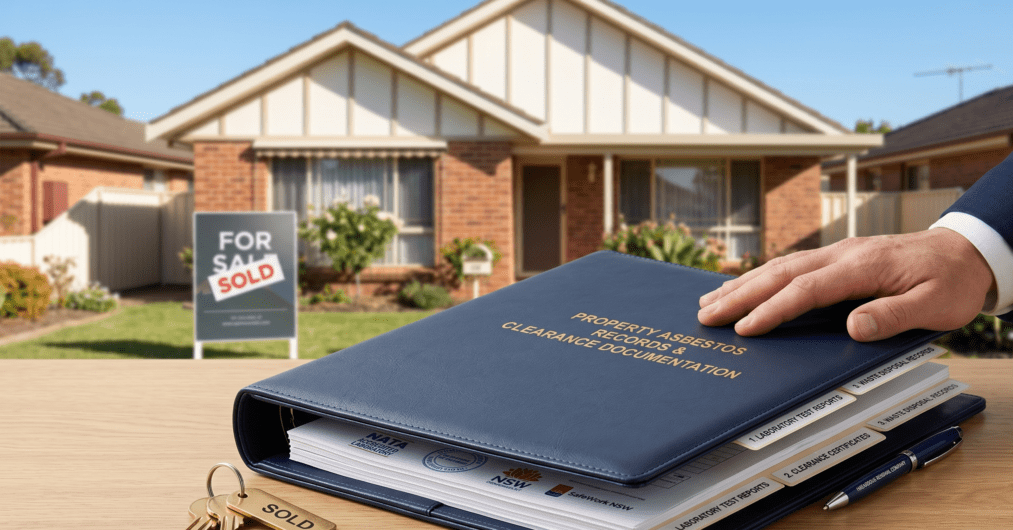
If asbestos has been tested, removed, or managed at your property, the following documents form a complete record. Each one serves a specific purpose during a property sale.
1. Laboratory Test Reports
The NATA-accredited laboratory reports from asbestos sample testing confirm what materials were tested, where the samples were taken, and whether asbestos was detected. These reports establish the factual basis for any removal or management decisions.
Value at sale: Proves the property was professionally assessed, identifies what was found, and demonstrates due diligence.
2. Clearance Certificates
The clearance certificate from an independent licensed assessor confirms that removal was completed and the site meets safe reoccupation standards.
Value at sale: Proves the asbestos was professionally removed (not DIY), independently inspected, and cleared. This is the single most important document in the asbestos paperwork chain.
3. Air Monitoring Results
Air monitoring results from a NATA-accredited analyst confirm that airborne fibre concentrations were within safe limits during and after removal.
Value at sale: Provides objective, measurable proof that the removal did not cause contamination beyond the work area. Particularly important for friable removal or any job where fibre release risk was elevated.
4. Waste Disposal Records
Waste Transport Certificates and disposal facility receipts document the chain of custody from your property to the EPA-licensed disposal facility.
Value at sale: Proves the asbestos waste was legally disposed of, not dumped or mixed with general waste. Eliminates any question about environmental liability.
5. Removalist Licence Details
A copy of the removalist’s SafeWork NSW licence (Class A or Class B) and their insurance details.
Value at sale: Confirms the work was done by a licensed professional, not an unlicensed operator. This matters because unlicensed removal work may not meet compliance standards, even if it appeared to be done correctly.
6. Asbestos Register (If Available)
An asbestos register that documents all known and suspected asbestos-containing materials across the property, including materials that remain in place and materials that have been removed.
Value at sale: Gives the buyer a complete picture of the property’s asbestos status. It answers the question “what else is there?” that a single clearance certificate cannot address.
What Happens When Documentation Is Missing
If you have had asbestos removed from your property but cannot produce documentation, you face several potential issues during a sale.
Buyer uncertainty. Without a clearance certificate, the buyer has no proof the removal was done correctly. They may assume the worst and request a price reduction to cover the cost of re-testing and potential remediation.
Solicitor pushback. The buyer’s solicitor may recommend against proceeding without documentation, or may require the seller to commission a retrospective asbestos assessment before settlement. This adds cost and delays.
Insurance complications. Some home insurance policies ask about asbestos when assessing risk. If the buyer’s insurer asks about asbestos and the documentation is absent, the buyer may face higher premiums or coverage limitations.
Negotiation leverage. Savvy buyers will use the absence of documentation as a negotiation point. “You say the asbestos was removed, but there is no clearance certificate. We want $10,000 off the price to cover our own assessment and potential removal.” This is a common negotiation tactic, and it is difficult to counter without documentation.
The cost of producing proper documentation at the time of removal is built into a professional removal quote. The cost of not having it at the time of sale is unpredictable and almost always higher.
Retrospective Documentation
If you have already had asbestos removed but did not receive complete documentation, you have limited options.
Contact the removalist. If the company that did the work is still operating, they may have records of the job on file. Ask for copies of any documentation they can provide.
Arrange a retrospective assessment. A licensed assessor can inspect the areas where removal was reportedly carried out and provide a current assessment of the site condition. This is not as strong as a clearance certificate issued at the time of removal, but it demonstrates current due diligence.
Commission new testing. If there is any doubt about whether all asbestos was removed, new sample testing can confirm whether asbestos-containing materials remain. This gives the buyer current, verified information.
Create an asbestos register. Even if the original removal documentation is lost, a current asbestos register that documents the property’s status as of today provides valuable information for buyers.
None of these retrospective options are as clean as having the right documentation from the start. But they are better than selling a pre-1990 property with no asbestos information at all.
For Properties Where Asbestos Remains in Place
Not every property that contains asbestos has had it removed. Many Sydney homes built before 1990 still contain bonded asbestos in good condition: intact eave linings, undamaged wall sheeting in garages, stable vinyl floor tiles. This material does not necessarily require immediate removal.
If you are selling a property where asbestos is known to be present but has not been removed, the strongest approach is transparency supported by documentation.
Have the property tested. A professional asbestos assessment documents what is there, where it is, and what condition it is in.
Create an asbestos register. An asbestos register formally documents all known asbestos materials and their condition. This gives the buyer a clear picture and a management reference.
Provide the register to interested buyers. Proactively sharing the register during the sales process demonstrates transparency and eliminates surprises during building inspections.
A property with a documented asbestos register and materials in good condition is easier to sell than a property where the asbestos question is unanswered. Buyers fear the unknown more than they fear a known, documented, and managed risk.
Build the File Now
If you are reading this and thinking about selling your Sydney home in the next few years, start building your asbestos documentation file now. Get the property tested. If removal is needed, use a licensed removalist who provides clearance certificates and disposal records. File everything permanently.
The investment in documentation pays for itself at the point of sale, in faster settlements, fewer solicitor objections, and a property that presents as professionally managed.
Contact Hazardous Removal Company for asbestos testing, removal, or register preparation. We provide complete documentation packages with every job. SafeWork NSW licence AD213403.