
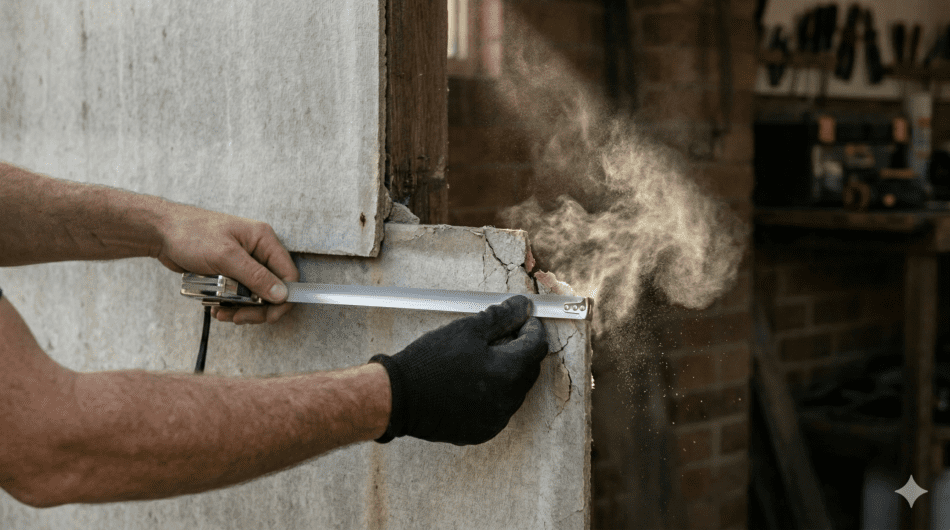
There is a rule in NSW that allows homeowners to remove up to 10 square metres of bonded asbestos from their own property without a licence. On paper, it sounds reasonable. In practice, it gives untrained people permission to handle one of the most dangerous building materials ever used.
This rule has good intentions. But the consequences of how it plays out in the real world are worth questioning.
What the 10 Square Metre Rule Actually Says
Under the Work Health and Safety Regulation 2017 in NSW, a person can remove up to 10 square metres of bonded (non-friable) asbestos from a residential property without holding a SafeWork NSW removal licence. The material must be bonded, meaning it is firmly bound in a cement matrix and not crumbling, powdery, or damaged.
The homeowner must still follow specific safety requirements. These include wearing appropriate PPE, wetting the material, not using power tools, wrapping and labelling the waste, and transporting it to a licensed disposal facility.
There is no equivalent allowance for friable asbestos. Any amount of friable material requires a Class A licensed removalist, full containment, and air monitoring.
The Problem With Giving Untrained People a Green Light
The rule assumes that a homeowner can accurately identify bonded asbestos, assess its condition, and remove it safely. Each of those assumptions carries real risk.
Identification is harder than people think. Asbestos was mixed into more than 3,000 different products. It does not have a single look or texture. Compressed sheeting, vinyl floor tiles, adhesive mastics, backing boards, and pipe insulation all look different from each other. Without laboratory testing, a homeowner cannot confirm what type of asbestos they are dealing with, or whether the material they think is bonded is actually beginning to deteriorate into a friable state.
Condition assessment requires training. Bonded asbestos that has been weathered, water-damaged, cracked, or partially broken can release fibres just like friable material. The line between “bonded and stable” and “bonded but deteriorating” is not always obvious to someone without experience. A licensed assessor knows what to look for. A homeowner with a YouTube video does not.
10 square metres is bigger than most people estimate. A standard single garage wall is roughly 7 to 8 square metres. A bathroom ceiling and two walls can easily exceed 10 square metres combined. Homeowners often start removing what they believe is a small area, only to discover the material extends further than expected. At that point, they are already past the legal limit and may have already contaminated the area.
What Happens When DIY Removal Goes Wrong
The consequences of a botched DIY asbestos removal range from health exposure to financial penalties.
Fibre release. The most serious risk is inhaling asbestos fibres during removal. Even bonded material releases fibres when broken, cut, or dropped. Without proper containment and wetting procedures, those fibres become airborne and can be inhaled by the homeowner, family members, and neighbours. There is no safe level of asbestos exposure. Every exposure adds to cumulative risk.
Cross-contamination. Asbestos fibres are microscopic. They settle on clothing, furniture, carpets, and surfaces throughout the home. A homeowner who removes sheeting from a garage and walks back into the house in the same clothes has just carried fibres into the living space. Professional removalists use full decontamination procedures including disposable suits, boot washes, and sealed waste bags for exactly this reason.
Improper disposal. Asbestos waste must be double-wrapped in 200-micron polyethylene sheeting, clearly labelled, and taken to a facility licensed to accept it. The disposal fees are not cheap. Some homeowners, facing unexpected costs, are tempted to dump the material in general waste, skip bins, or bushland. Illegal dumping of asbestos carries fines of up to $1 million for individuals under the Protection of the Environment Operations Act 1997 in NSW.
No clearance certificate. When a homeowner removes asbestos themselves, there is no independent verification that the area is safe. A licensed asbestos removal job includes a clearance certificate issued by a licensed assessor confirming the site meets safety standards. DIY removal produces no such documentation. This can create problems when selling the property or when future work is carried out on the same area.
The Information Gap
One of the biggest issues with the 10 square metre rule is the gap between the written requirements and what actually happens on the ground.
SafeWork NSW publishes guidance on how to safely remove small quantities of bonded asbestos. The guidance is detailed and specific. But most homeowners do not read it. They search “can I remove asbestos myself in NSW,” get a yes/no answer, and proceed with whatever tools they have in the shed.
Online forums and social media groups are full of well-meaning but dangerous advice. “Just wet it down and bag it.” “Wear a dust mask and you’ll be fine.” “I did mine on the weekend, no problems.” These anecdotes normalise a task that professional removalists train for, licence for, and insure for.
The gap between what the regulation requires and what untrained homeowners actually do is where the harm occurs.
What Other States and Countries Do Differently
The 10 square metre allowance is not universal. Different jurisdictions take different approaches.
In Queensland, the threshold is also 10 square metres for bonded asbestos, but the requirements around notification and disposal are slightly different. In Victoria, the rules are similar but enforcement mechanisms vary. In the ACT, following the Mr Fluffy loose-fill insulation crisis, regulations around any asbestos disturbance are notably stricter.
In the UK, non-licensed work on certain lower-risk asbestos materials is permitted, but a notification requirement to the Health and Safety Executive applies in many cases. In the US, regulations vary by state, but federal OSHA and EPA rules impose strict requirements on any asbestos disturbance in commercial settings.
The point is not that NSW has the worst rules. The point is that every jurisdiction struggles with the same tension: allowing homeowners some autonomy while preventing uninformed people from creating health hazards.
A Better Approach
The 10 square metre rule does not need to be abolished. But it would work better with two additions.
Mandatory testing before removal. If a homeowner wants to use the 10 square metre allowance, they should be required to have a professional asbestos test confirm the material is bonded and in stable condition. This single step would prevent homeowners from accidentally disturbing friable material or deteriorating sheeting.
A simple notification system. Requiring homeowners to notify their local council before self-removing asbestos would create a record of where asbestos has been handled and allow councils to follow up on disposal compliance. This already exists for licensed removalists who must notify SafeWork NSW before starting work.
Neither of these additions would be expensive or burdensome. They would simply close the gap between what the regulation assumes and what actually happens.
What You Should Do Instead
If you have found or suspect asbestos in your home, the safest approach is always to start with professional testing. Even if the area is under 10 square metres, knowing exactly what you are dealing with changes everything.
A sample test costs far less than a removal job. It confirms whether the material contains asbestos, what type of asbestos is present, and whether the material is in a condition that is safe to handle. That information lets you make an informed decision about whether DIY removal is genuinely appropriate for your situation, or whether a licensed removalist is the smarter choice.
For most homeowners, especially those with families in the home, the peace of mind that comes with professional removal and a clearance certificate is worth the cost.
Contact Hazardous Removal Company to arrange testing or to get a free quote on removal. We hold SafeWork NSW licence AD213403 and provide clearance certificates on every job.