
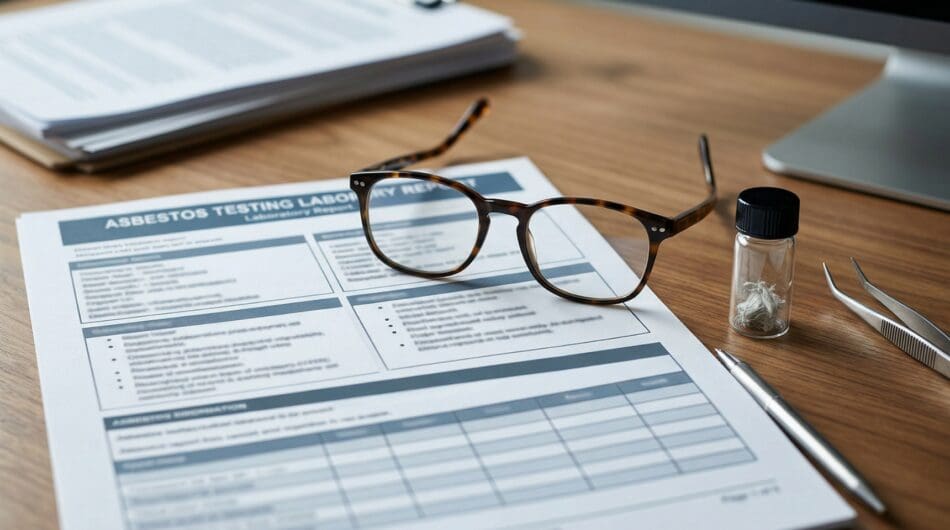
You arranged an asbestos test on your property. A licensed assessor collected samples from your walls, ceiling, or flooring. The samples went to a NATA-accredited laboratory. A few days later, you received a report.
And now you are staring at a document full of terms like “chrysotile detected,” “no asbestos detected (NAD),” and “PLM analysis” wondering what any of it means for your renovation plans.
Lab reports are written for professionals. But the information in them belongs to you. Here is how to read the key sections so you can make informed decisions about what happens next.
What a NATA-Accredited Lab Report Looks Like
In Australia, asbestos sample analysis must be performed by a laboratory accredited by the National Association of Testing Authorities (NATA). This accreditation means the lab follows standardised methods, maintains quality controls, and produces results that are legally defensible.
A typical lab report from a sample test includes several sections. The layout varies between laboratories, but the core information is consistent.
Header information: The lab’s name, NATA accreditation number, the date samples were received, and the date of analysis. This establishes the chain of custody and confirms the report comes from an accredited source.
Sample identification: Each sample is assigned a unique ID number. The report will list the sample ID alongside a description of where it was collected. For example: “Sample 1: Wall lining, bathroom, ground floor” or “Sample 3: Eave soffit, north elevation.” This is critical because it links the lab result to a specific location in your property.
Analytical method: The report will state which method was used. The two most common methods for bulk sample analysis are Polarised Light Microscopy (PLM) and Dispersion Staining. Some labs also use Scanning Electron Microscopy (SEM) for more complex samples. PLM is the standard method for most residential testing.
Results: This is the section that matters most. For each sample, the lab will report one of three outcomes.
The Three Possible Results
1. No Asbestos Detected (NAD)
This means the laboratory did not identify any asbestos fibres in the sample using the analytical method applied. It is the result every homeowner wants to see.
One important detail: “No Asbestos Detected” is not the same as “guaranteed asbestos-free.” The result applies to the specific sample tested. If asbestos is present in a different part of the same material, or in a different layer beneath the surface, a single sample may not capture it. This is why assessors take multiple samples from different locations and materials across the property.
If all samples from a specific area return NAD, you can proceed with reasonable confidence that the material does not contain asbestos.
2. Asbestos Detected (with type identified)
If asbestos is present, the report will identify the specific type. There are six recognised types of asbestos, but three account for the vast majority of materials found in Australian homes.
Chrysotile (white asbestos): The most common type found in residential buildings. It was used in cement sheeting (fibro), roof tiles, vinyl floor backing, pipe insulation, and hundreds of other products. Chrysotile accounts for roughly 90% or more of asbestos used in Australian construction.
Amosite (brown asbestos): Less common than chrysotile but still found in insulation boards, ceiling tiles, cement sheeting, and thermal insulation products. Amosite fibres are more rigid and considered more hazardous per-fibre than chrysotile.
Crocidolite (blue asbestos): The least common in residential settings but the most dangerous. Crocidolite has thin, needle-like fibres that penetrate deep into lung tissue. It was used in some pipe insulation, spray-on coatings, and cement products. Any detection of crocidolite should be taken seriously and discussed immediately with your assessor.
The report may also note the estimated percentage of asbestos in the sample. For example: “Chrysotile detected, approximately 10-15% by volume.” Higher percentages mean more asbestos fibre is bound into the material, but any confirmed detection requires the same safety precautions during removal.
3. Inconclusive or Requires Further Analysis
Occasionally, a sample cannot be definitively classified using PLM alone. This can happen when the material is heavily degraded, when fibre content is very low, or when the sample matrix makes identification difficult. In these cases, the lab may recommend further testing using SEM or another method.
An inconclusive result does not mean the material is safe. It means more information is needed before a decision can be made.
Understanding Friable vs. Non-Friable in the Report
Some lab reports or assessor reports will note whether the material is classified as friable or non-friable (bonded). This distinction has direct implications for how the material must be handled.
Non-friable (bonded): The asbestos fibres are firmly bound in a solid matrix, such as cement sheeting or vinyl tiles. When intact and undisturbed, bonded materials generally pose lower immediate risk. Removal of bonded asbestos requires a Class B or Class A licensed removalist.
Friable: The material can be crumbled, pulverised, or reduced to powder by hand pressure. Friable materials release fibres far more readily than bonded materials. Removal of any quantity of friable asbestos requires a Class A licensed removalist, full containment, negative air pressure, and independent air monitoring.
If your report identifies friable asbestos, the urgency and cost of removal increases. Discuss the findings with your assessor and removalist immediately.
What the Report Does Not Tell You
A lab report confirms whether asbestos is present in the specific samples submitted. There are several things it does not cover.
Condition assessment. The lab analyses the material composition. It does not assess the physical condition of the material in your home. A separate on-site assessment by the licensed assessor determines whether the material is deteriorating, damaged, or at risk of disturbance.
Risk assessment. The lab does not tell you how dangerous the material is to your family in its current state. Risk depends on the material’s condition, location, likelihood of disturbance, and whether it is in a living space or an enclosed area. Your assessor interprets the lab results in the context of your specific property.
Scope of contamination. The lab tests the samples it receives. If the assessor collected three samples from three locations, the results apply to those three locations. Asbestos may be present in other materials or areas that were not sampled. A thorough assessor will sample all suspect materials and common locations to minimise gaps.
Removal recommendations. The lab report does not tell you what to do. That guidance comes from the assessor’s report and from discussions with your licensed asbestos removalist.
How to Use Your Lab Results
Once you have your report, here are the practical next steps.
If all samples return NAD: You can proceed with renovation planning with reasonable confidence. Keep the report on file. It forms part of your property’s documentation and may be useful during a future sale or renovation.
If asbestos is detected in one or more samples: Do not disturb the material. Contact a licensed asbestos removalist to discuss removal options, costs, and timing. If you are mid-renovation, all work in the affected area must stop until the asbestos is professionally removed and a clearance certificate is issued.
If crocidolite (blue asbestos) is detected: Treat this with additional urgency. Crocidolite is the most hazardous type and is classified as friable in many applications. Discuss the findings with your assessor and removalist before taking any action near the material.
If the result is inconclusive: Follow the lab’s recommendation for further testing. Do not assume the material is safe because the result was not a clear positive.
Keeping Your Report on File
Your lab report and assessor’s report should be kept permanently with your property records. These documents serve three purposes.
Renovation planning. Any future renovation work on the property can reference the testing report to determine which areas have been tested and cleared.
Property sale. Buyers and their solicitors increasingly request asbestos documentation. A clear testing record demonstrates due diligence and avoids delays during the conveyancing process.
Asbestos register. For homeowners who want a formal record of all known asbestos materials in their property, the lab report feeds directly into an asbestos register. While not legally required for residential properties in NSW, a register provides comprehensive documentation that simplifies future maintenance and renovation decisions.
The Bottom Line
Your asbestos lab report is not just a formality. It is the foundation of every decision that follows: whether to renovate, how to renovate, and what safety steps are needed before work begins.
If anything in your report is unclear, ask your assessor to explain it. A good assessor will walk you through the results in plain language and help you understand what they mean for your specific property and plans.
Contact Hazardous Removal Company for professional asbestos testing with clear, explained results. We hold SafeWork NSW licence AD213403 and use NATA-accredited laboratories for all sample analysis.