
Air monitoring during asbestos removal is one of those line items that separates a compliant job from a cheap one. It adds cost. It adds time. It requires an independent third party. And for those reasons, some removalists in Sydney quietly leave it out.
Not because it is optional (for many jobs, it is legally required). Not because it is unnecessary (it is the only objective measure of whether the removal was safe). They skip it because it is an expense that most homeowners do not know to ask for and will never miss from a quote.
Here is why that matters, how to spot a quote that has left it out, and what questions to ask before you sign.
Why Air Monitoring Exists
Air monitoring during asbestos removal serves one primary function: it provides objective, measurable evidence that airborne asbestos fibre concentrations remained within safe limits during the removal work.
Without monitoring, the only assurance you have is the removalist’s word that the job went well. With monitoring, you have laboratory data from a NATA-accredited analyst showing exactly what was in the air at the boundary of the work area and inside the removal zone after cleaning.
That data feeds directly into the clearance certificate. It provides the foundation for the assessor’s determination that the site is safe for reoccupation. And it protects you, the removalist, and any future occupants of the space if questions ever arise about how the job was conducted.
When It Is Legally Required
Under the Work Health and Safety Regulation 2017 in NSW, air monitoring is required for:
All friable asbestos removal. Any quantity. The monitoring must be conducted by a competent person independent from the removalist and must include exposure monitoring (during removal) and clearance monitoring (after removal and cleaning).
Licensed asbestos removal work where there is a risk of exposure. The Regulation and the How to Safely Remove Asbestos Code of Practice require the person conducting the business or undertaking (PCBU) to carry out air monitoring if there is uncertainty about whether the exposure standard might be exceeded.
For bonded asbestos removal exceeding 10 square metres (which requires SafeWork NSW notification), air monitoring is effectively a standard expectation as part of the asbestos removal control plan.
For smaller bonded removal jobs under 10 square metres, air monitoring is not strictly mandated in all circumstances. This is the grey area that some removalists exploit.
Why Some Removalists Leave It Out
The reasons are straightforward and financial.
Cost. Engaging an independent air monitoring technician and NATA-accredited laboratory analysis adds $500 to $2,000 or more to a residential removal job, depending on the number of samples and the monitoring duration. For a removalist quoting a small job at $2,000 to $3,000, that monitoring cost represents a significant percentage of the total quote.
Competitive pressure. In a market where homeowners compare quotes based primarily on the bottom-line number, the removalist who includes monitoring looks more expensive than the one who leaves it out. If the homeowner does not understand the difference, they choose the cheaper quote.
Homeowner ignorance. Most homeowners do not know what air monitoring is, when it is required, or that it should be part of the job. If the removalist does not mention it, the homeowner does not ask for it. The job gets done. The homeowner assumes everything was handled properly. Nobody checks.
Enforcement gaps. While SafeWork NSW has the authority to inspect asbestos removal sites and enforce compliance, the practical reality is that inspectors cannot attend every residential removal job. Removalists operating in the residential market know that the likelihood of a site inspection on a small job is low.
None of these reasons make skipping air monitoring acceptable. But they explain why it happens.
What Happens When Monitoring Is Skipped
When air monitoring is not conducted, several things are lost.
No exposure data. There is no record of what the airborne fibre concentration was during the removal. If anyone on site (workers, homeowner, neighbours) was exposed to elevated fibre levels, there is no data to quantify or disprove it.
Weaker clearance certificate. A clearance certificate issued without supporting air monitoring data relies entirely on the visual inspection by the assessor. While a visual inspection is valuable, it cannot detect fibres in the air. A clearance based on visual inspection alone is less robust than one supported by laboratory air monitoring results.
No baseline for future claims. If a health concern arises years later and someone questions whether the removal job was the source of exposure, there is no air monitoring data to reference. With data, you can point to results showing fibre levels were below the National Exposure Standard. Without data, you have nothing.
Compliance gap. For jobs where monitoring was legally required (friable removal, notifiable bonded jobs), skipping it is a breach of the Work Health and Safety Regulation. The removalist is non-compliant. The homeowner, as the PCBU for their property, may also have exposure depending on the circumstances.
How to Spot a Quote That Skips It
Comparing asbestos removal quotes is not just about the total price. The line items tell you whether the job will be done properly.
A compliant quote for a residential asbestos removal job should include or reference the following items:
Removal labour and materials. The physical work of removing the asbestos.
Containment. Polyethylene sheeting, tape, and negative air units (for friable work).
PPE and decontamination. Disposable suits, respirators, and decontamination arrangements.
Air monitoring. Either included as a line item in the quote or noted as a separate engagement with a named monitoring provider. If the quote includes air monitoring, it should state how many samples will be taken and where.
Clearance inspection. Engagement of an independent licensed assessor to issue the clearance certificate after removal.
Waste disposal. Transport and disposal at an EPA-licensed facility with waste tracking documentation.
If a quote includes removal, containment, and disposal but does not mention air monitoring or a clearance inspection, those items have been left out. The total price will look lower, but the job will not include the objective safety verification that protects you.
Red Flags in Quotes
No mention of air monitoring anywhere. Not in the scope, not in the inclusions, not in the assumptions.
“Clearance by our team.” The clearance must be done by an independent assessor, not the removalist. If the removalist says they do their own clearance, the independence requirement is not met.
A single lump-sum price with no breakdown. Without line items, you cannot identify what is included and what has been left out.
Significantly lower than other quotes. If one quote is 30 to 50% cheaper than two or three competing quotes for the same scope, ask what is not included. The price difference is often explained by the absence of monitoring, clearance, or compliant disposal.
Questions to Ask Before You Sign
Before engaging any asbestos removalist, ask these specific questions about air monitoring.
“Will air monitoring be conducted on this job?”
If yes, ask who will conduct it (should be an independent technician or laboratory, not the removalist’s own staff) and how many samples will be taken.
If no, ask why not. If the job involves friable asbestos or more than 10 square metres of bonded asbestos, monitoring is expected. If the removalist cannot explain why monitoring is not needed for your specific job, get a second opinion.
“Who is the air monitoring provider?”
The provider should be identifiable by name and should hold NATA accreditation for asbestos fibre counting. If the removalist cannot name their monitoring provider, or if they say they use their own in-house monitoring, dig deeper.
“Will I receive a copy of the air monitoring results?”
You should receive the full laboratory report as part of your job completion documentation, alongside the clearance certificate and waste disposal records.
“What happens if a monitoring result exceeds the safe limit?”
A professional removalist will have a procedure: stop work, investigate the cause (containment breach, inadequate wetting, unexpected material condition), implement corrective actions, and re-sample before continuing. If the removalist does not have an answer to this question, they may not have thought through their monitoring process carefully.
“Is air monitoring included in your quote or is it an additional cost?”
Either answer is acceptable, but you need to know. If monitoring is an additional cost, get a figure so you can compare total costs between quotes on a like-for-like basis.
What Good Monitoring Looks Like
On a properly monitored residential asbestos removal job, you should see the following:
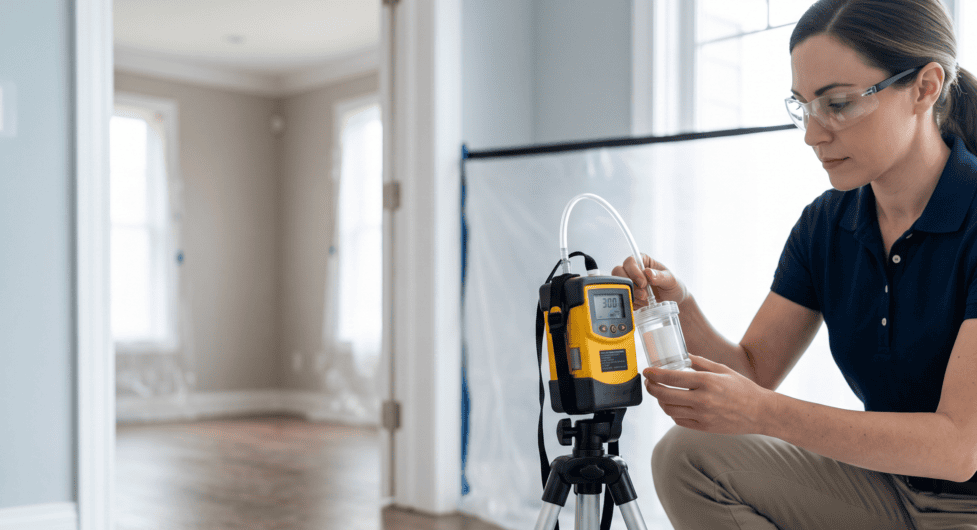
An independent technician arrives at the site before removal begins and sets up sampling pumps at defined boundary and background locations. The pumps run continuously during the removal work.
After the removal and site decontamination are complete, the technician sets up clearance sampling pumps inside the former removal area. These pumps run for a defined period (typically two to four hours) to collect a representative sample.
All filter cassettes are sealed, labelled, and sent to a NATA-accredited laboratory for analysis. The laboratory report is provided to the removalist, the independent assessor, and the homeowner.
The clearance certificate references the air monitoring results and confirms that all readings were below the National Exposure Standard.
The homeowner receives the monitoring report as part of their documentation package and files it with their property records.
That is the standard. That is what compliance looks like. And it is what every homeowner paying for professional asbestos removal should expect.
Contact Hazardous Removal Company for asbestos removal with independent air monitoring on every job. We hold SafeWork NSW licence AD213403 and provide full documentation including monitoring results, clearance certificates, and waste disposal records.